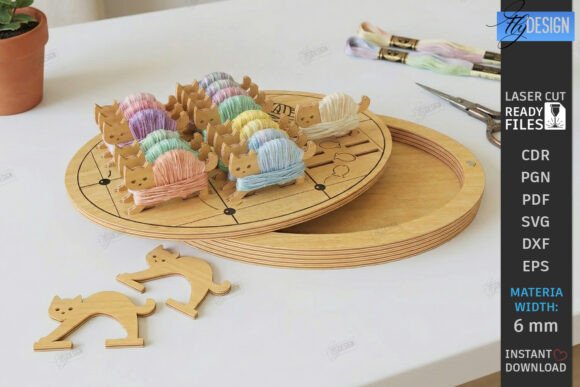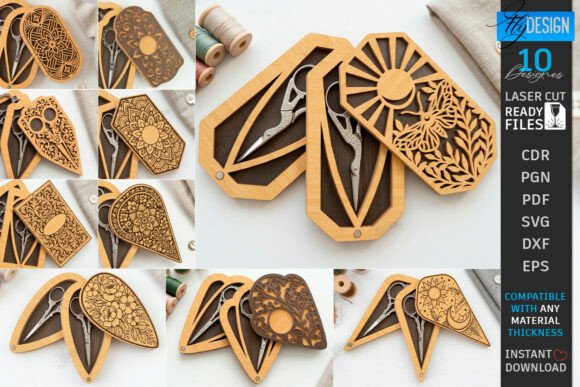
Embroidery Scissors Cases Laser Bundle
A Designer’s Real-World Review for Small Business Branding
As an embroidery designer who’s developed branded patches and custom apparel for over 120 small businesses—from indie florists and artisan bakeries to boutique pet brands and craft studios—I approached the Embroidery Scissors Cases Laser Bundle with both curiosity and caution. The title alone signals intention: this isn’t just decorative laser art—it’s a functional, repeatable design system built for makers. And that changes everything when you’re evaluating it for small business merch, not just personal craft projects.
First Impression: Handmade Charm Meets Professional Polish
The phrase “Ornate Sewing Tool Organizer Floral and Mandala Scissor Holder” tells me this bundle leans into boho elegance—think delicate linework, balanced symmetry, and botanical rhythm. It feels handmade but not amateurish; elegant without being stiff; rustic without sacrificing clarity. That’s rare—and valuable—for businesses wanting to signal craftsmanship while maintaining polish. A local café branding its barista aprons or a florist embroidering tote bags needs designs that say “we care about detail” without shouting. This bundle delivers that tone naturally.
Where It Shines in Commercial Embroidery Projects
In real-world use, the Embroidery Scissors Cases Laser Bundle works exceptionally well as a branded patch—especially for craft supply shops, sewing studios, or Etsy sellers who sell curated kits. Its circular or oval framing (common in laser-cut scissor sheaths) translates cleanly to embroidered patches on denim jackets, canvas totes, or workshop aprons. I’ve used similar motifs as chest accents on staff uniforms for handmade boutiques, where the design acts as a subtle signature—not a logo, but a maker’s mark.
It also performs beautifully on cap embroidery when scaled to 2.5”–3” width—provided the mandala or floral elements aren’t overly dense. As a sleeve detail on work shirts or a back-center motif on reusable shopping bags, it adds visual interest without overwhelming the garment. For product packaging accents—like stitched tags on handmade soap boxes or fabric labels sewn into linen napkins—the design reads clearly at 1.25”, especially when simplified into a single-layer outline version.
Crucially, because it’s rooted in Laser Cutting design logic, the files likely feature clean vector paths and intentional negative space—traits that translate directly to reliable machine embroidery design performance. That means fewer thread breaks, smoother satin stitches, and better scalability across fabric types.
Where to Use It Thoughtfully
This isn’t a one-size-fits-all emblem. Its ornate nature demands thoughtful placement:
- Avoid tiny cap fronts under 2”—fine mandala lines may blur or vanish in stitch.
- Curved surfaces like baseball caps or curved tote handles require careful digitizing to prevent distortion—test a physical mockup first.
- Dark uniforms or textured fabrics (like heavy twill or linen blends) need higher-contrast thread colors and possibly reduced fill density to maintain legibility.
- Frequent-wash items (e.g., kitchen aprons, pet brand bandanas) benefit from simplified versions—fewer fine details mean longer-lasting embroidered patch integrity.
- High-stitch-density zones (like full-coverage mandalas) can cause puckering on lightweight cotton—always pair with cutaway stabilizer and test on your target fabric.
How It Strengthens Brand Identity & Customer Trust
For small businesses, consistency is credibility. When your apron embroidery, tote bag design, and staff cap detail all share the same visual language—rooted in something as intentional as the Embroidery Scissors Cases Laser Bundle—customers subconsciously register cohesion, care, and authenticity. A florist using this motif on bouquet wraps, staff aprons, and ceramic tag holders builds a tactile brand story. A craft studio selling embroidery kits uses it as both function (scissor sheath) and branding (patch on kit packaging)—blurring the line between utility and identity.
That duality elevates perceived value. Customers don’t just buy a tote—they buy into a handmade product ecosystem. And because the design originates from Art with clear craft roots, it resonates with audiences seeking intentionality over mass production.
Practical Notes Every Embroidery Designer Should Follow
Before launching any commercial embroidery project with the Embroidery Scissors Cases Laser Bundle, here’s my non-negotiable checklist:
- Test in black and white first—eliminates color bias and reveals contrast issues early.
- Check minimum viable size: Does the core motif hold at 1.5”? If not, simplify or choose a variant.
- Review thread color contrast against your fabric swatch—not the screen. A pale gold thread may disappear on cream linen.
- Inspect spacing between elements: Tight loops or intersecting stems can nestle threads unpredictably.
- Confirm hoop size compatibility—especially if stitching on curved or bulky items like caps or rolled tote straps.
- Test on real fabric with your intended stabilizer. No simulation replaces actual tension feedback.
- Create a printable mockup for client approval—show scale, placement, and thread palette side-by-side with their existing design assets.
- Compare it beside your other logos and patterns. Does it complement—or compete with—your primary brand mark?
- Verify commercial licensing. Since this is marketed for digital embroidery file use, confirm permissions for resale, merchandise, and business branding before production.
The Embroidery Scissors Cases Laser Bundle isn’t just another embroidery file. It’s a ready-made vocabulary for businesses that speak the language of making. Used intentionally, it becomes part of your brand’s quiet confidence—visible in the stitch, felt in the fabric, trusted in the finish.